Symmetry, Agency, and the Evolution of Idealistic States
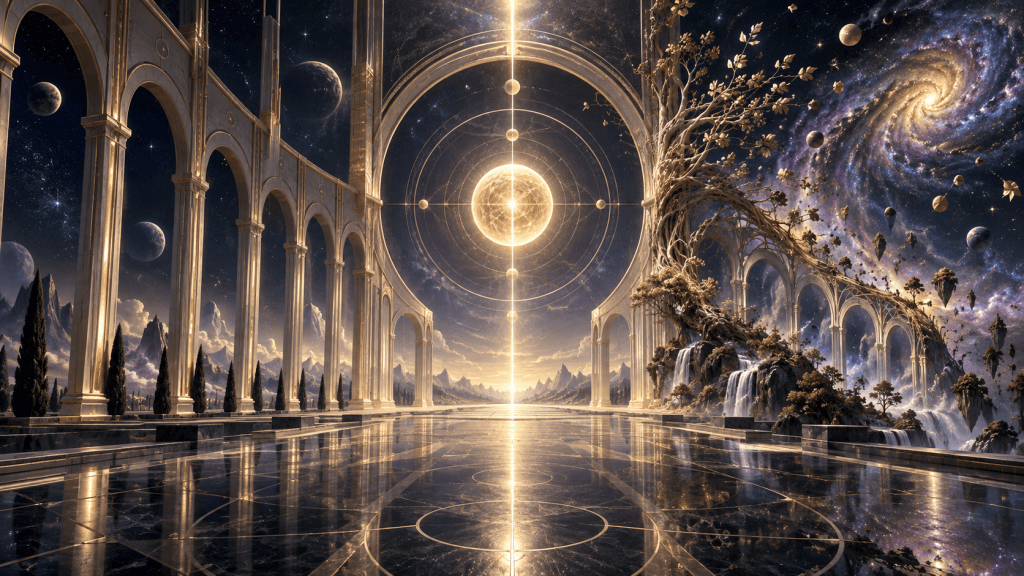
A form of idealistic perfectionism has become embedded within many contemporary postmodern-influenced movements—and embedded within this concept of idealism is an emphasis on symmetry. Symmetry, in this case, is a force of constraint and compression that helps reduce unnecessary and detrimental elements. This symmetrically induced idealism is evident not only in secular postmodernism but also in religion. Christianity, Islam, Buddhism, and many others promote a final destiny in the realm of symmetrical idealism: Christianity’s heavenly realm, Islam’s Jannah, Buddhism’s Nirvana, among others.
The prevailing interpretation of each religious paradigmatic destiny, again, is that of symmetry. They are all states in which deviations from the ideal (sin, dhanb, karma) do not exist, which would thus mean no free will either. Comparatively, many postmodernists perceive a utopian society wherein everyone exists in synchronous harmony. In this utopia, offenses of any kind are nonexistent.
Again, both religious and secular forms of idealism articulate a similar underlying proposition: symmetry results in harmony. This proposition is, in essence, correct; however, only in part. Yes, more symmetry will result in an increase in harmonic constraints. However, the tradeoff is that increasing constraints inevitably decreases the opportunity for free will, thus transforming a utopian society into a dystopian nightmare.
Though increased symmetry (constraints and compression) is a necessary and productive part of nature, it is also a process that must be moderated. As with nearly every process within space-time, there is a fundamental zone of proximal development. This proximal development of symmetrical attributes is especially evident in the process of evolution.
As species have evolved, they have increased in sophistication while simultaneously increasing in efficiency and efficacy, which are symmetrical attributes. Not only do organisms increase in symmetrical sophistication, but the process of adaptation itself provides increased symmetry through constraints and compression. Each generation experiences adaptive adjustments that increase efficiency and efficacy through selective constraining pressures (compression and consolidation). If the process were forced too abruptly, adaptation would not result.
Similarly, on a grander scale, one can observe the gradual evolutionary and adaptive process throughout the expansion of the universe—from the chaos of the initial phases of the Big Bang to the ordered elegance of the expansive web of galaxies one can observe today. It is through this process of increased symmetry, constraints, and compression that order is achieved. That said, however, this degree of order still possesses an underlying flux of primordial chaos that allows the cosmos to persist in an organic, adaptive, and malleable fashion.
Without adaptability (chaos/potential), developmental progression toward a stable and functional state (order/organization) cannot occur. However, the functional state is not a final state; instead, it must maintain an oscillating flux for functionality to persist. An excessive emphasis on order and organization negates the very essence of an authentically functional state.
Of course, the same can be stated regarding a constant desire for progression (adaptability/potential). An ever-evolving system cannot sustain itself without sufficient periods of integration that result in functional stability. Constant progression never allows for the sufficient assembly of novel adaptive information.
Both secular and religious emphases on a hypothetical idealistic state of existence, conceptualized as either a utopian society or heavenly realm, are merely conceptual attempts at symmetric rigidity. Both scenarios represent symmetrical, two-dimensional conceptualizations that negate agency and potentiality. They are therefore projections of hyper-rationalistic fantasies generated by undeveloped minds. This undeveloped status characterizes minds that no longer adapt to novel information but have instead become possessed by constrained perceptual schemas. They are traditionalists in the sense that they conserve formulated interpretive and idealistic elements that have been constrained and consolidated into a systematic formula. Linearity and inanimation are fundamental illustrative elements of this systematic formula.
Of course, much of what has been illustrated thus far is but a glimpse of what was articulated by the original conceptualizers, especially on the religious front. Therefore, what has been analyzed here concerns only the common interpretations of such conceptualized idealistic states. However, the underlying formulation of these paradigmatic conceptualizations is something quite different from their common interpretations. For example, the traditionally common interpretation of the Christian articulation of the heavenly realm is predicated upon the assumption of a perfected state. However, the biblical descriptions of such a place appear to reflect something quite distinct from the traditional interpretation.
According to both the Old and New Testaments, Lucifer was the highest angelic being in the heavenly realm, yet he is illustrated as exhibiting agency through his attempted ascension to the status of God. This agentic attempt is what ultimately led to his fall from this perceived idealistic state. It is this narrative that directly contradicts the traditional interpretation: asymmetry manifested within a symmetrical realm. A strictly symmetrical state provides no room for agency (asymmetry).
Given the evolutionary nature of religious belief—evident throughout the Mesopotamian religions that heavily influenced the writers of both the Old and New Testaments—it appears quite plausible that the concept of the heavenly state, too, is evolutionary. Over the millennia, the concept of idealism evolved and adapted alongside the growing informational sophistication of ancient scholars, as reflected in both law and religious ideals. Increased symmetry is a fundamental adaptive element of this conceptualization; however, it is also accompanied by the asymmetrical nature of being itself, which is demonstrated through the complementary relationship between sin and free will. This agentic proclivity of human existence is what allows learning and adaptation to occur, and it is that which provides the essence of connective realism among the individual, the collective, and reality as such.
Therefore, the idealistic state is an adaptive mode of symmetrical and asymmetrical qualities interacting within a larger connective field of functional potential. As a species evolves through its acquisition of information and advanced technologies, idealism itself evolves in relation to past, present, and future states. Within this integrative and adaptive space-time flux exists a constant oscillatory progression toward an ever-evolving, functionally potentiated state.

