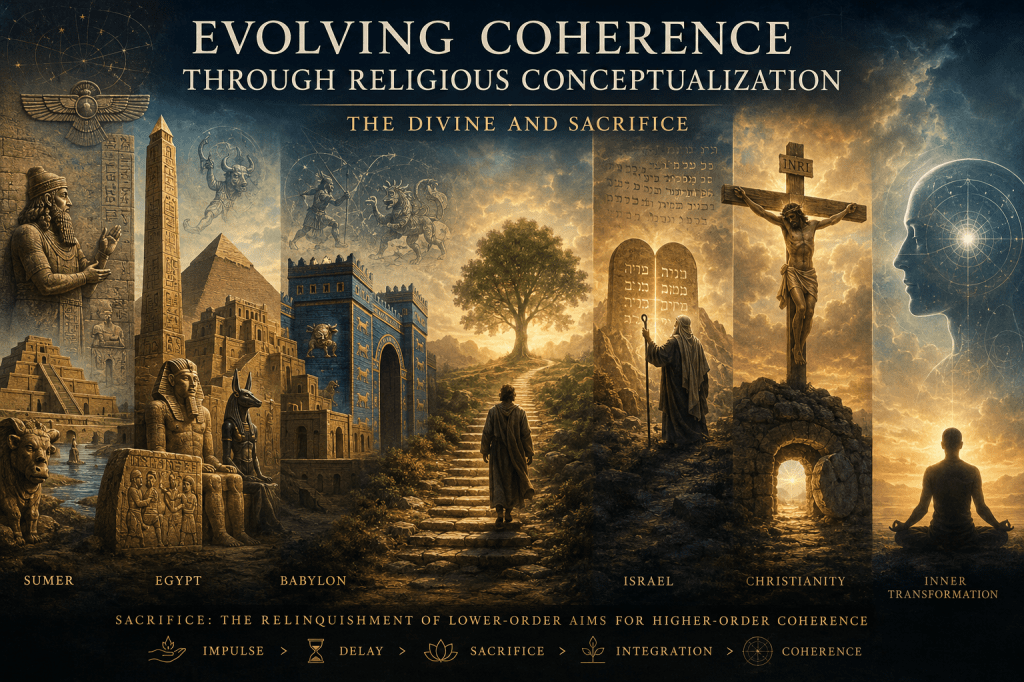
Sacrifice is the essence of human success. It is through the sacrifice of what is expedient in exchange for that which is meaningful that our predecessors were able to survive. It is the ability to forego what we would most want to do in the present (consummatory reward) in exchange for that which will matter most in the future (incentive reward). Without such sacrifice, humanity would not have adapted to the various selection pressures—e.g., climate change, increased nourishment requirements, mate attraction—all of which helped us evolve into the species we are today. Therefore, sacrifice is axiomatic to the process of long-term propagated success.
This concept evolved in complexity with the invention of writing, wherein it became an axiom embedded within religious and mythological narratives. From ancient Sumer and Egypt to Babylon and Persia, and later in Judaism and Christianity, the concept of sacrifice as a means to ascend (evolve) was pivotal. In the Sumerian story of Gilgamesh, Enkidu’s death forces Gilgamesh to confront the fantasy that the existing self can remain unchanged, prompting his arduous quest for immortality and, ultimately, a transformed relationship with mortality itself. Later in Babylon, the story of Marduk and Tiamat represents a similar pattern of sacrificing comfort to contend with potential that results in habitable order.
With the emergence of the Old Testament writings beginning around the first millennium BCE came another evolution of the concept of sacrifice. During this period, the religion of the ancient Israelites developed amid a contention between polytheistic traditions and an increasingly monotheistic orientation over several centuries. Psychologically, this can be interpreted as the collective consciousness seeking to unify its perception of the self and reality as such. Consequently, monotheism took center stage, and with it came a transformation of both the concept of God and the orientation of sacrifice. It was not sacrifice itself that evolved, but rather the object of sacrifice. No longer were sacrifices made to multiple gods that constituted a pantheon; instead, these were increasingly unified around the divine figure of Yahweh. Thus, the process of sacrifice was directed toward a unified orientation that reduced complexity while potentially increasing the efficacy of both the individual’s and collective’s everyday lives. In addition, this move may have reduced some of the ambiguity commonly found within preceding pantheistic religions.
Psychologically, the move toward unification of the divine can be interpreted as an evolutionary shift in the collective human psyche: toward increased coherence through stronger constraints upon the underlying value system. The various aims of the collective archetypes were unified into a single, overarching figure that was symbolic of the unified aim of success. To achieve any established goal, one must sacrifice the things necessary to trek toward that goal. Religion amplified this concept through the ideal representation of Yahweh and the various patriarchs and matriarchs found within the narratives of the Old Testament.
Christianity continued this evolving theme through the person of Christ. This manifestation of the divine in the flesh provided a physical representation that increased relatability with the divine aspect of human nature. In doing so, participants of the faith could resonate with the unified divine physical manifestation in a profoundly meaningful way. The incarnation may have reduced some of the abstraction inherent in an unseen transcendent God by embodying the divine ideal within a human form. This potential reduction in ambiguity may have thus increased feelings of certainty for the individual. This increased certainty was not solely a religious theme but one of precision in aim as well, reflecting a higher resolution of consciousness.
Consequently, this increase in precision of the aim of human value and meaning resulted in a sophistication of the concept of sacrifice itself. The archaic conceptualization of sacrifice as the physical shedding of blood from a particular animal was reconfigured through Christ. Animal sacrifice was no longer needed to connect with the divine and achieve whatever aim one had in mind. Instead, humanity was to follow the example of Christ, which psychologically can be interpreted as requiring the sacrifice and transformation of rigid ego-identifications through a descent into the unconscious. Thus, sacrifice led to the rebirth of the individual, enabling them to move closer to the goal (the divine).
Over time, this ongoing process would help unify the individual through the death of the parts of the self that were no longer necessary. It is the elimination of expedient distractions in exchange for meaningful engagement. Not only does this process tend to develop the individual, but it can alter their relationship with reality as well. As one continues to make the necessary sacrifices, the resulting transformations tend to impact opportunities and other individuals. “Successful” individuals throughout history can attest to this effect.
Psychological literature suggests that increased coherence is associated with greater psychological well-being. In addition, when this coherence is befitted with meaningful aims and the necessary sacrifices, the individual may become healthier both physically and psychologically. Thus, it is imperative—just as the ancients may have come to understand through trial, error, and the formation and evolution of religious concepts—that both the individual and society cultivate meaningful psychological coherence. Such coherence requires the continual sacrifice of lower-order aims, rigid identifications, and expedient desires in service of a more integrated orientation toward value and meaning. Sacrifice, in this sense, is not merely loss. It is the relinquishment through which higher-order organization becomes possible.

