“Individuation and the Challenge of Integration in the Age of Distraction”
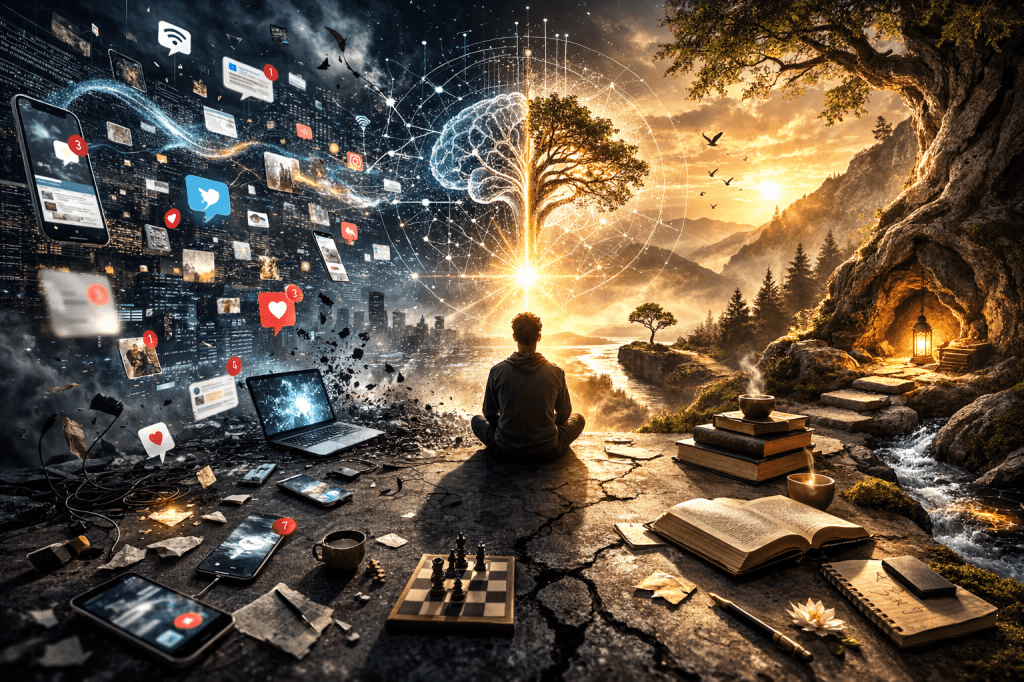
Human cognition is a complex mechanism by which one is able to develop conceptual systems that provide coherent perceptions of the world around them. It is within these conceptual systems that meaning structures develop throughout life, acquired through our interactions with the world. It is a bidirectional process wherein we use our current systems to navigate the world, while at the same time updating those systems with novel information we encounter along our way. Additionally, these systems are not only used in navigating physical reality but conceptual spaces such as books and lectures.
As we encounter such novelty, we process it through our current perceptual models that filter information that is relevant to our preexisting structure. Useful information is assimilated into that structure while contradictory or ambiguous information is either manipulated to fit one’s preexisting structure or ignored. Only through practice can one develop skills to acknowledge and then critically think on that information to see how to accommodate it into their current structure. This is often accomplished by reconfiguring the structure to fit the information which, depending on the degree of reconfiguration, reorganizes one’s perception in a dramatic manner.
The process of accommodation is an adaptive process, and it appears to be the means that helped the human species excel so rapidly in our evolutionary history. Since the emergence of Homo sapiens some 200,000 years ago, we have adapted to all types of environments, invented language and art, developed religious ideas, constructed monumental structures of symbolic significance (Tattersall, 2013; Donald, 1991).
All these adaptable achievements have significantly improved our survivability as a species, and they have led us to the convenient society that we currently inhabit. Despite these adaptable achievements, modernity has provided conveniences that appear to have limited our adaptability trait. We have now become more reliant on the achievements of humanity rather than on the intrinsic drive that helped lead us to such achievements.
It is here that much of humanity has traded innovation and discovery for novelty seeking and satiation. Consequently, a fragmentation of the psyche has plagued many as is evidenced in attentional diffusion, identity polarization, and reduced ambiguity tolerance, while a narrowing of perceptual value that prioritizes stimulation emerges as the meaning-making medium. Thus, modern digital environments disproportionately reward rapid salience detection over sustained integrative reasoning, potentially complicating the process of individuation and adaptive meaning-making.

Something went wrong. Please refresh the page and/or try again.
Into the Depths of the Unconscious
Regarding the significance of accommodation of novel information, Jung went further with this concept into the depths of the unconscious. He believed that an encounter with novel information was not just strictly a need for perceptual reconfiguration through accommodation, but rather it was something more profound than that. Wrestling with novel information was a journey into both the individual and collective unconscious wherein the individual contends with concealed and unknown parts of the Self. In mythology, this is symbolized as the hero’s descent into the unknown where they confront and overcome the dragon of chaos in hopes of transforming both themselves and society and restoring order in due process (Jung, 1968).
Jung thought this process to be imperative for the individual to pursue throughout their life, especially as they matured into old age. In fact, he believed individuation to be the very essence of maturation. It is a cyclical endeavor where an individual encounters novel information, contends, integrates, and reconfigures their psyche, which is then pursued once again until unification is achieved. As one contends with new information/unconscious forces, over time they gradually unify their psyche into a coherent and stable structure, thus mimicking, to a degree, the process of human evolution itself on a micro scale. Consequently, if one does not participate in such experiences, fragmentation and confusion results (Jung, 1968).
Modernity and Meaning-Making:
Modernity presents an issue for many regarding the process of individuation as it presents an overwhelming amount of information while also providing too many distractions. Information overload — both quantity and quality — exhaust the process of individuation as the information becomes a dragon too large and diverse to contend with. Similarly, the vast amounts of distractions in the forms of smart phones, social media, gaming, and other forms of entertainment, beckon for one’s attention and thus diversify and reduce cognitive resources (Korte, 2020).
With the induction of smart phones with their portability and instant access to a wealth of information and entertainment, habitual patterns of cognitive engagement may be shifting (Korte, 2020). Social media and their algorithmic configurations that develop in accordance with an individual’s salience and emotional vulnerabilities have been associated with reduced sustained engagement in effortful material in some individuals (Turel et al., 2014; Montag & Diefenbach, 2018). Instant access to content that is stimulating and novel and requires short attentional effort has further compounded the issue (Alter, 2017; Leroy, 2009; Ophir et al., 2009). What were designed to be utilized as tools to help stimulate the curiosity of the human mind has now become the pacifier of the weary (Orben & Przybylski, 2019). Convenience and entertainment have blunted the intrinsic drive of innovation and curiosity.
Sustained attention is essential in the engagement and completion of any complex and meaningful task. However, technology has significantly reduced our ability to sustain attention by increasing attentional volatility through persistent task switching common among avid smart phone users (Leroy, 2009; Castelo et al., 2023). Skowronek et al. (2023) have found that even the mere presence of a smart phone can reduce attentional performance.
Comparatively, reading skills have also experienced a significant decline since the inception of smart phones. Wolf (2018) found a reduction in inferential processing when using digital platforms compared to tangible prints for reading. Similarly, Delgado et al. (2018) conducted a meta-analysis on the effects of digital vs printed reading on contextual comprehension and found print outperformed digital. The Programme for International Student Assessment (PISA, 2022) revealed a decline in reading performance across several industrialized nations. Good reading skills are essential in acquiring and contending with novel information, especially as the complexity of what is being read increases.
Both attention and reading skills are essential in attending to and acquiring novel information that can be evaluated, contended with, and integrated. Thus, without such attributes and skills, the process of individuation becomes exceptionally difficult. Additionally, the amount and diversity of information that has resulted from increased internet access and globalization has only compounded this issue (Alsaleh, 2024). The modern person is thus overwhelmed and overextended to the point of exhaustion.
Unifying Attention and Developing Reading Skills
To properly attend to anything in life, one must set their complete attention to whatever it maybe they are desiring to attend to. By narrowing down on the substance or experience at hand, the vital information contained within can then emerge. Jung revealed this as vital concealed information as the “treasure” that was protected by the dragon depicted in classic mythology and fairy tales. Only by attending to the treasure can one retrieve what is essential for integration. For example, when Moses in the story of Exodus encounters the burning bush, he turns his attention to it and it was this attention that allowed for the disclosure of vital information to manifest out of it. In cognitive terms, sustained attention enables the extraction of latent complexity from stimuli that would otherwise remain perceptually inert.
Similarly, by developing good reading skills by engaging with books that pushes one’s current skill level, that development can occur. Not only does reading development transpire, but concealed information hidden within the complexity emerges during engagement that can help develop the Self as well. This, of course, often requires disciplined and focused reading that may also necessitate pauses for contemplation on particular passages or retreat to a dictionary for improved comprehension of difficult words. However, it is here that one’s comprehension of both the Self and reality can improve that leads to wholeness and greater well-being.
Developed and Unified Self in the Modern World
Modernity is not in and of itself a root cause of the fragmentation of attention or decline in reading ability, nor is it the impediment of the individual drive towards innovation and transformation. Rather, the fundamental issue is both the collective’s and individual’s propensity to allow the commodities of modernity to overwhelm and suppress the intrinsic human capacity for adaptive integration. What is needed is not a rejection of modernity but a regulation of one’s own attention and resource allocation. How and where, one directs one’s attention and resources will determine what resourceful treasures they may discover.
By reducing unnecessary distractions while narrowing one’s attention on the essentials, they can then begin to increase efficiency in everyday life. However, even more importantly, they can then devote their extra time that was previously invested in a variety of overwhelming stimulus into investigating the more profound parts of reality and their Self. Investing resources and attention towards challenging information where one can wrestle with the unconscious elements of both the collective past and the Self. Therein is where concealed “truths” can be made manifest that will allow for integration and reconfiguration. It is this reconfiguration that transforms what was unknown into the useful known that is unified, innovative, and more aware than before.



References:
Alsaleh, A. The impact of technological advancement on culture and society. Science Report, 14, 32140 (2024). https://doi.org/10.1038/s41598-024-83995-z
Alter, A. (2017). Irresistible: The rise of addictive technology and the business of keeping us hooked. Penguin Press.
Castelo, N., Bos, M. W., & Lehmann, D. R. (2023). Task switching and attentional fragmentation in digital environments. Journal of Experimental Psychology: General, 152(4), 1023 — 1041.
Delgado, P., Vargas, C., Ackerman, R., & Salmerón, L. (2018). Don’t throw away your printed books: A meta-analysis on the effects of reading media on reading comprehension. Educational Research Review, 25, 23 — 38. https://doi.org/10.1016/j.edurev.2018.09.003
Donald, M. (1991). Origins of the modern mind: Three stages in the evolution of culture and cognition. Harvard University Press.
Jung, C. G. (1968). The archetypes and the collective unconscious (R. F. C. Hull, Trans.). Princeton University Press. (Original work published 1959)
Korte, M. (2020). The impact of the digital revolution on human brain and behavior: Where do we stand? Dialogues in Clinical Neuroscience, 22(2), 101 — 111. https://doi.org/10.31887/DCNS.2020.22.2/mkorte
Leroy, S. (2009). Why is it so hard to do my work? The challenge of attention residue when switching between work tasks. Organizational Behavior and Human Decision Processes, 109(2), 168 — 181. https://doi.org/10.1016/j.obhdp.2009.04.002
Montag, C., & Diefenbach, S. (2018). Towards Homo digitalis: Important research issues for psychology and the neurosciences at the dawn of the Internet of Things and the digital society. Sustainability, 10(2), 415. https://doi.org/10.3390/su10020415
Ophir, E., Nass, C., & Wagner, A. D. (2009). Cognitive control in media multitaskers. Proceedings of the National Academy of Sciences, 106(37), 15583 — 15587. https://doi.org/10.1073/pnas.0903620106
Orben, A., & Przybylski, A. K. (2019). The association between adolescent well-being and digital technology use. Nature Human Behaviour, 3, 173 — 182. https://doi.org/10.1038/s41562-018-0506-1
Skowronek, J., Seifert, A., & Keller, S. (2023). The mere presence of smartphones reduces cognitive performance: A meta-analytic review. Computers in Human Behavior, 139, 107537.
Tattersall, I. (2013). Masters of the planet: The search for our human origins. Palgrave Macmillan.
Turel, O., He, Q., Xue, G., Xiao, L., & Bechara, A. (2014). Examination of neural systems sub-serving Facebook “addiction.” Psychological Reports, 115(3), 675 — 695. https://doi.org/10.2466/18.PR0.115c31z8
Wolf, M. (2018). Reader, come home: The reading brain in a digital world. Harper.

