This week’s episode of The Truth Cast Show features special guest, Dr. Paul Copan. Dr. Copan is a professor of philosophy at Palm Beach Atlantic University and author of “Is God A Moral Monster?” wherein he helps both Christians and non-Christians attain a better understanding of the Old Testament law, and other difficult to understand passages and commands. He is also author/editor of many other books and articles. In this episode, I sit down with Dr. Copan to discuss his book on the Old Testament, his career as a philosopher, Christian apologetics, and more.
On the first episode of The Truth Cast Show, Christian philosopher Michael Thacker examines the evidence for the narrative of the Garden of Eden, and that of the first two conscious human beings, Adam and Eve.
The common belief among both mainstream Christian theologians and pastors is that the universe was created in six literal days, and that the Garden of Eden was located in the Persian Gulf sometime around 4,000 BC. And yet, what evidence is there to support this idea? Evidence thus far accumulated through the various scientific practices have revealed that the universe is in fact not created in six days, but rather evolved over the course of billions of years. And the location of the Garden of Eden could not have been located in the Persian Gulf region as the last time that the Persian Gulf was dry was approximately 15,000 BP. Now, in this article I will only briefly address the issue of the age of the universe later in the article to help to instantiate the proper background of the ideas I will be presenting here. However, I will be addressing not only a new proposed date for the time of the Garden of Eden, but the location of its existence and the evidence of Adam and Eve’s existence as well.
Genealogical Gaps:
To begin our journey of discovering a possible answer to the Garden of Eden and man’s expulsion thereof, I would like to take a moment to address a much debated dilemma both within the educational and church domain, that is the genealogical record found within the book of Genesis. Many scholars and pastors alike whole heartedly believe that the genealogical record found within Genesis is accurate and with no legitimate gaps within. And what is it that convinces them of the conceptional interpretation? The infallibility of God’s word-gaps imply a sense of imperfection and unreliability. And yet, in reality the concept of gaps within the generational record does not imply imperfection, but rather suggests that the author of Genesis provided names and ages for a generalized record to provide readers with references. The names and ages are accurate and in order, but there were more names within that did not make the list due to the overly vast amount of space and time it would take, not only the author to list them out, but for the reader as well. What evidence is there to back up such a claim? The dating of both Adam and Noah with correlated archaeological and geological evidence that suggests a much older date for their residence here on earth.
The Location of The Garden of Eden:
For many scholars and pastors, the Garden of Eden resided somewhere in the location of today’s Persian Gulf. But is there any evidence to suggests this to be valid? According to these same Persian Gulf advocates and their interpretation of genealogical record found in Genesis, Adam and Eve existed sometime around 4,000 BC. But the issue with the concept is that according to geological records, the Persian Gulf has been submerged in water since approximately 15,000 BP, which of course contradicts any habitation by an early dating of Adam and Eve. So, is the location wrong? Or is the approximate dating of 4,000 BC wrong? Both.
The next issue that arises for a Persian Gulf residence for the Garden of Eden is found within scripture itself:
“Now a river went out of Eden to water the garden, and from there it parted and became four riverheads.”
Genesis 2:10 NKJV
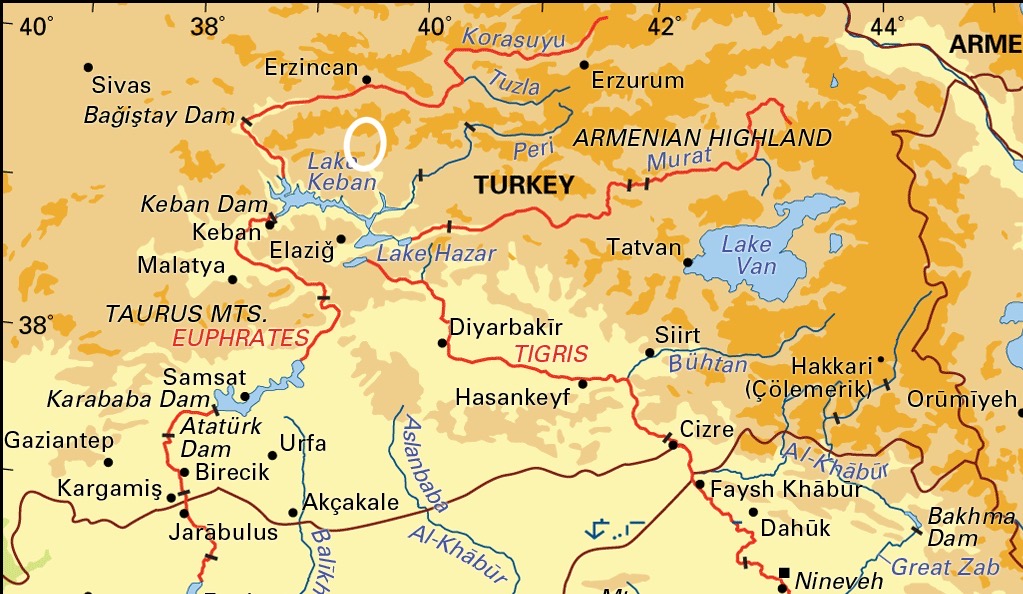
Here we find a clear indication that a river proceeded forth out of Eden by the use of the Hebrew word “yatsa,” which means to go out, go forth, or exit. We then find that the river then parted into four different rivers, of which scenario we find at the Persian Gulf contradicts this description. The river Euphrates comes down from Turkey and through Iraq, and then pours into the Persian Gulf, of which does not fit the description of a river coming out of this region and parting into four distinct river heads. And rather, what we do find is that this description fits perfectly with region of modern day Turkey, this is where we find four distinct rivers, including that of the river Euphrates issuing forth from this region. The first map below reveals the flow pattern of this set of rivers while the second map shows the proposed location via a small white circle of the Garden of Eden.
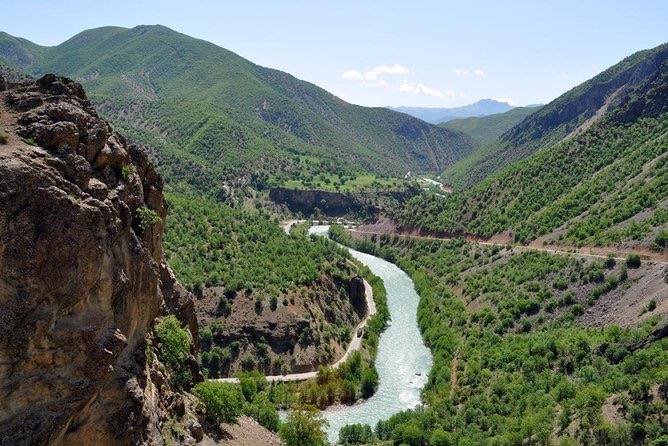
This particular region of modern day Turkey is where the Munzur Valley National Park resides, and the location in which the Munzur River initiates. And from there the river runs down the valley into Lake Keban where, ironically, a four riverhead system is revealed, including the Euphrates and Tigris, as well as the Peri and Murat. And thus fitting the description of a river flowing out of the Garden of Eden into a four riverhead system. As far as the lands of Cush and Havilah mentioned in Genesis two for the location of the other two rivers, their precise location is still up for debate. And at this moment no other river mapping system fit the description for a branch of four rivers that include both the Euphrates and Tigris.
Not only do we find that this river system seems to be a rather unique fit with what is given to us in Genesis 2, but the region, or valley wherein the Munzur River proceeds forth from fits the description of the Garden of Eden rather well, too. This particular valley is filled with trees of various sorts, including, ironically, fruit trees such as wild pears and apples, as well as walnut and hazelnut trees. There is also an abundance of wildlife that includes wild goats, boar, hare, gray wolf, fox, bears and more. Within the river itself there is also an array of various fish life, as well as waterfalls, setting the scene for a Garden of Eden film like scene.
The Date Of The Garden Of Eden:
As mentioned earlier, not only is the traditional location of the Garden of Eden seemingly inaccurate, but the dating as well. Traditional Bible scholars and pastors alike believe the earth to be as young as 4,000 years old, and yet where do they derive their evidence of this particular dating from? The derivation comes from a literal interpretation of both the six days of Genesis 1, and the genealogical record found throughout the book of Genesis. But how accurate is this interpretation? According to orthodoxic Christian theology, the Bible is inerrant, which means that it should be interpret literally word for word, and yet we can see where this would lead someone into a heap of trouble when executing this idea when applied to certain pieces of scripture, like that of cutting off your hand if it causes you to sin. Not all scripture is to be interpreted literally with this idea being highly plausible with both the six days of Genesis and the genealogical record.
According to mainstream science (of which God created), the universe is approximately 13.7 billion years old, and the earth sits at 4.6 billion years old. If you find it difficult to try and understand how the earth would be so old within the confines of six days, think of the days mentioned in Genesis as transpiring outside our space-time universe in the realm of God. Remember, Peter stated that one day to the Lord was as a thousand years. If you would like to obtain a better understanding of this idea, I highly recommend The Science of God written by Dr. Gerald Schroeder. Likewise, the first appearance of homo-sapiens (modern humans) appeared around 200,000 years ago. But it wasn’t until about 12,000 BP that we see the first evidence for the human invention of agriculture and the domestication of animals. Why is this important for our topic? According to the account in Genesis, Adam and Eve, as well as their sons, were the very first farmers and shepherds.
“Before any plant of the field was in the earth and before any herb of the field had grown. For the Lord God had not caused it to rain on the earth, and there was no man to till the ground.”
“Out of the ground the Lord God formed every beast of the field and every bird of the air, and brought them to Adam to see what he would call them. And whatever Adam called each living creature, that was its name. So Adam gave names to all cattle, to the birds of the air, and to every beast of the field.”
Genesis 2: 5,19-20 NKJV
Notice the word field being used in both passages mentioned, as well as “no man to till the ground”, implying a time prior to the invention of organized agriculture. But also, in the second and third verses mentioned above, God didn’t bring every creature to Adam to name, only those of the field and air. The Hebrew word used here for field is “sadeh’”, which means cultivated field, country, ground, land, or soil. This same word is often used in reference to a field that is of sustainable quality for the cultivation of crops and domestication of farm animals. Moreover, we see this concept of Adam and Eve and their children being the first farmers within the context of chapter 4 of Genesis, after the expulsion from the Garden. Here we find that Able was a ordained a shepherd while Cain was a tiller of the ground.
“Now Adam knew Eve his wife, and she conceived and bore Cain, and said, ‘I have acquired a man from the Lord.’ Then she bore again, this time his brother Abel. Now Abel was a keeper of sheep, but Cain was a tiller of the ground.”
Genesis 4: 1-2 NKJV
As the text reads, we see the introduction of agriculture and animal domestication into the world, according to scripture that is. But is there any archaeological evidence for this that lines up with this narrative? Taking a step back to Genesis chapter 3, the time of the fall, we find that after the expulsion of both Adam and Eve, God puts a Cherubim to guard the tree of life eastward of the Garden of Eden.
“So He drove out the man; and He placed cherubim at the east of the Garden of Eden, and a flaming sword which turned every way, to guard the way to the tree of life.”
Genesis 3:24 NKJV
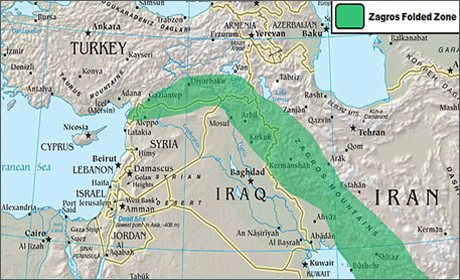
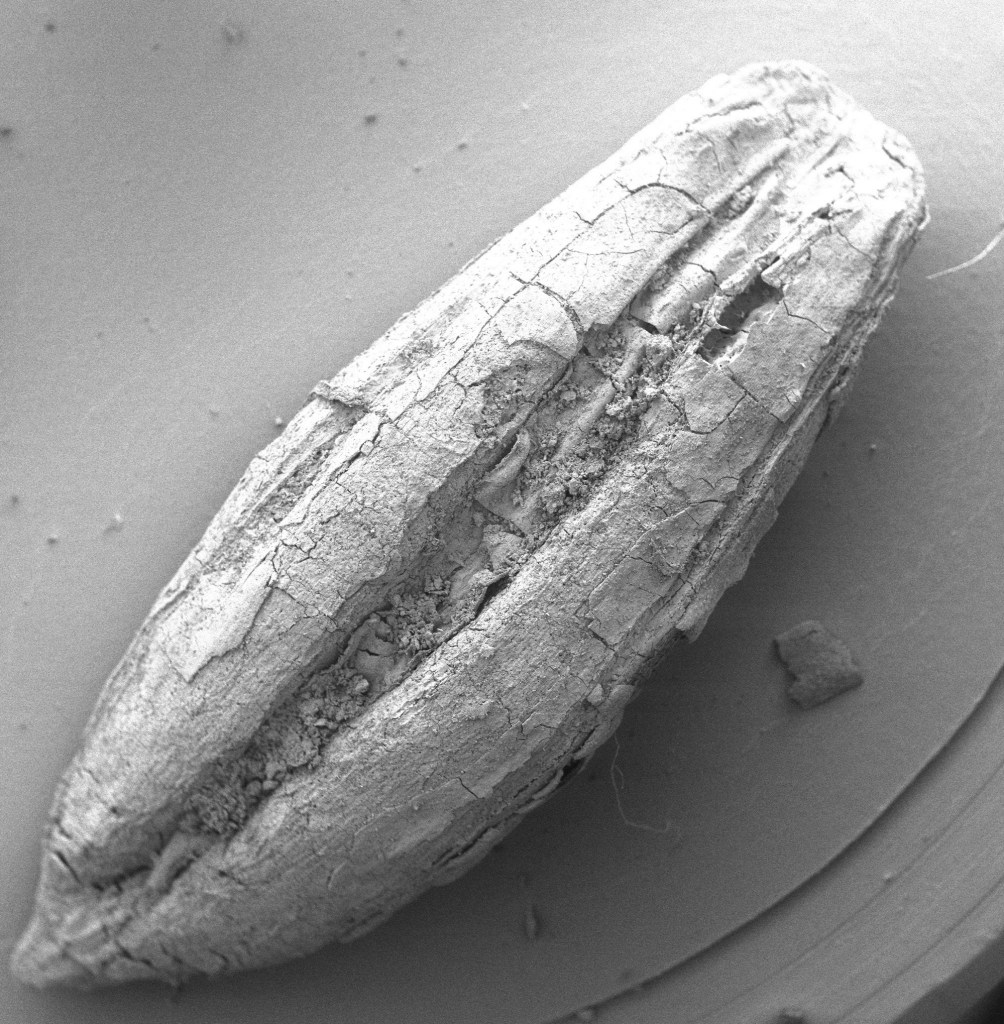
With the cherubim being placed at the eastern part of the Garden of Eden, which the Hebrew word being used is “qedem”, meaning east or relatively east. Used properly in its context, it seems rather plausible, as the text implies, that Adam and Eve were driven east of the Garden of Eden. Now, reflecting upon what we have discussed thus far with the new proposed location of the Garden being situated in the eastern part of Turkey, it would seem as though there should be signs of the first farmers and animal domesticators present somewhere nearby. Ironically enough, a few hundred miles east/southeast of this exact location is the Zagros mountain range, wherein lies the archaeological evidence for the world’s first farmers and animal domesticators, all of which date back 12,000 years ago. Both agriculture and animal domestication arose in this area with the cultivation of barley, peas, and lentils being discovered in sites dating back 12,000 years ago. And at the same time evidence for the domestication of both goats and sheep, of which the account in Genesis tells us that Abel took care of. If this is in fact evidence for the story of Adam and Eve, not only does this change the interpreted geography of the narrative, but it also pushes the initial perceived date of 4,000 BC back 8,000 years.
In conclusion, here I wanted to briefly summarize some of the evidence that I have acquired over the years, and at the same time correlate this accumulative evidence with that of the narrative found within the first few chapters of Genesis. My work is far from complete, and the desire and will to put all the acquired evidence within this article would have been exhausting for both myself and the reader. But, I am currently working on a book that will not only cover all of the accumulative evidence for the Garden of Eden and the first two fully conscious human beings, but for Noah, Abraham, Joseph, and the story of the Exodus. Not only will the new bits of evidence connect and shed light on these stories, but will also require a complete dating revamp of the chronology of both the stories and their characters. If you would like to help support my work and research, you can by donating either by clicking the Patreon link below, or by donating through the PayPal link below. Thank you and God bless.
-Michael Thacker
Want to know more? Watch Michael’s new show where he will be explaining many of his new found evidence and teachings on YouTube live every Sunday at 5 pm central time: The Truth Cast Show
The first lesson of a series of lessons focused on Christian apologetics and philosophy. During this first lesson, I go on to explain how important our beliefs are and how those beliefs go on to affect our entire mode of being. It is essential to understand what it is that you believe as an individual in the world, and whether or not those beliefs correlate with reality and scripture. I also go on to express the dire necessity in veering from ideological possession through the practice of critical thinking and logic. Check it out here:
One primary problem the church as a whole is facing is that of cowardice and it is only getting worse as time passes. Do not get me wrong, there are a few good soldiers out there fighting the good fight, but overall the church is collapsing under pressure from within and outside. Not only do we see this happening to the church as a whole, but with individual Christians as well. We see it when they are faced with opposing forces of the faith as well as their own personal lives when faced with obstacles.
This weakness, so to speak, can be traced back about 150 years or so, and of course can be found elsewhere as well, but for the sake of this argument let us look at the modern perspective only. With the rise of technology has brought with it the necessity of comfort, happiness, pleasure and the like. Now, I am not saying that these are bad and unnecessary within themselves, but rather that we have come to depend on them too much as vital parts of life instead of blessings to enjoy from time to time.
Not only is this seen within the church and individual Christians, but it is also seen within the world as a whole. The difference between the world and the church when it comes to the increase comfort and weakness is the fact that the world is a bit more headstrong and tough when it comes to dealing with issues, while the church feels the necessity to back down to opposition in order to exhibit meekness and love like Jesus. But how valid is this approach? Is this the way that Jesus responded to opposition? Or is this just a modern conceptualization?
To put things into perspective it is necessary to look at the Greek word for meekness and go from there. The Greek word is, “Praotes” which means to exhibit gentleness, mildness, meekness, but has also been interpreted by several scholars to mean, “One who has a weapon and knows how to use it, but keeps it set within their holster.” We are called to be meek, that is gentle while exhibiting the love of Christ to others, and yet at the same time we are called to be courageous, stand firm and be alert.
“Watch, stand fast in the faith, be brave, be strong.”
1 Corinthians 16:13 nkjv
The “stand fast” is the Greek word, “Steko” which means to stand firm, to persevere, to persist, to keep one’s standing. Even better is the phrase “be strong” which is the Greek word, “Krataioo” and literally means to be strengthened, make strong, increase in strength and vigor.
When trying to see how this correlates with the idea of meekness one only has to look at how Jesus reacted to the Pharisees in speech and conduct like the terms brood of vipers and turning the tables in the temple, and this type of action and speech, to our modern viewpoint, does not seem to meek. The way to better understand meekness, strength and courage is by not taking extreme, modern day viewpoints, and instead look at the meaning of words through the lenses of the ancient writers.
Life was much different 2,000+ years ago with no real stability present, no clean water or food, illnesses running rampant, thieves and thugs lying at every corner, no means of expeditious communication, ruthless governments and the like. The idea of meekness something much different to Paul, Peter, and even Jesus as they saw a much different world than we do today. They knew that they had to be strong and courageous in order to overcome the opposition and obstacles that came their way while doing it in as much gentleness as they possibly could do without being pushed over and trampled on.
“Have I not commanded you? Be strong and of good courage; do not be afraid, nor be dismayed, for the Lord your God is with you wherever you go.”
Joshua 1:9 nkjv
Just like Joshua in the Old Testament, we too need to be courageous if we want to fight the good fight and overcome, not only the opposition that comes against the church, but even our own personal battles and obstacles that try to inhibit us from accomplishing the call of God upon our life. We must come to understand that the Bible and the Christian life is predicated some much upon the idea of balance rather than extremes. We should seek to be gentle to all without being push overs, and yet exhibit courage and strength without becoming a tyrant of sorts. Where do you stand when it comes to exhibiting courage and meekness?








 Michael Thacker