Adaptive Engagement, Information Integration, and the Formation of Coherent Experience
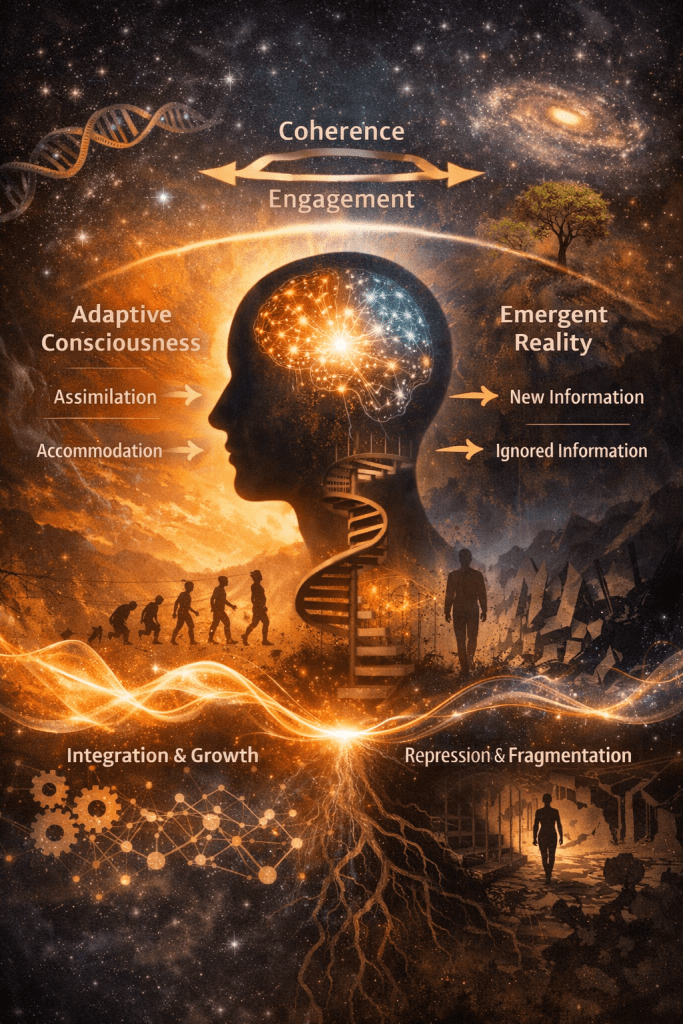
What and how one perceives is the direct consequence of conscious awareness in relation to the dimensions of space-time. Perception is influenced by an array of various interacting biological, cognitive and environmental systems and elements. The plethora of hormones, neural activity, and subatomic arrangement help develop a contextual panorama that provides essence to experience. However, how do all of these facets of experience form into a coherent model wherein meaning and experiential sustenance persist? The fundamental relational dynamic between a constrained evolutionary perceptual system and the continuous flow of emerging potential appears to encourage such coherent model formation. This encouragement is informational provision to the one who possesses the model — and it is up to how they utilize this information that dictates how the model develops.
Human consciousness is a fundamental perceptual constraint that results from millions of years of adaptive behaviors and thought processes. Over time, this system has stabilized into a coherent structure that provides humans with a pathway of interactive potential. As one engages with the environment, each interaction is an unfolding of coherent potentiality. These unfolding events are a bidirectional relational dynamic between the coherent adapted structure of consciousness and the stable potential of existence. These forces produce both coherence and manifest potential.
Though humanity has evolved this relational coherence between consciousness and reality, there are variations on the individual level. These variations are predicated upon past generational developmental experiences and the learned experiential scaffolds of the individual. If previous generations engaged at an insignificant level with reality, then the consequential developmental of subsequent generations are that of lower coherence. The same applies on the individual level — less engagement results in lowered coherence. The reverse, however, can be said if the engagement of both previous and present conscious participants is sufficient.
Sufficient relational engagement is a process of information acquisition followed by either assimilation or accommodation. Which process occurs is determined by the level of relational congruence between the information obtained and the preexisting structure of consciousness. If the information acquired is at least partially congruent with one’s consciousness, then simple assimilation can be proceeded. Contrarily, if the information is largely incongruent with this structure, then a process of accommodation must be engaged.
Accommodation requires a reconfiguration of the preexisting conscious model in a way that accommodates the novel information without losing its essence. If one chooses to forego this process when novel information is encountered, they then risk increasing incoherence. The reason for this increased risk rather than a more neutralized stagnation of consciousness is that the information is now evident within the structure.
Even if the individual sought to consciously discard the information, it would only transfer to the unconscious. Since the unconscious is the primitive foundational substrate of consciousness itself, any information that resides within that contradicts the coherence of the latter emergent model of consciousness will only weaken its structure. And the more information of this sort is ignored, the greater the risk of incoherence to the point of delusion occurs.
Therefore, it is paramount that an individual — and the generations preceding and proceeding from them — do not ignore novel information. With that said, novel information is the interactional sustenance by which consciousness can mature its frame of reference that further enhances the relational dynamic with being. The more one acknowledges and seeks to integrate encountered information into their preexisting model through comprehension and accommodation, the greater the coherence of that model within itself and its relationship with reality.
 Michael Thacker