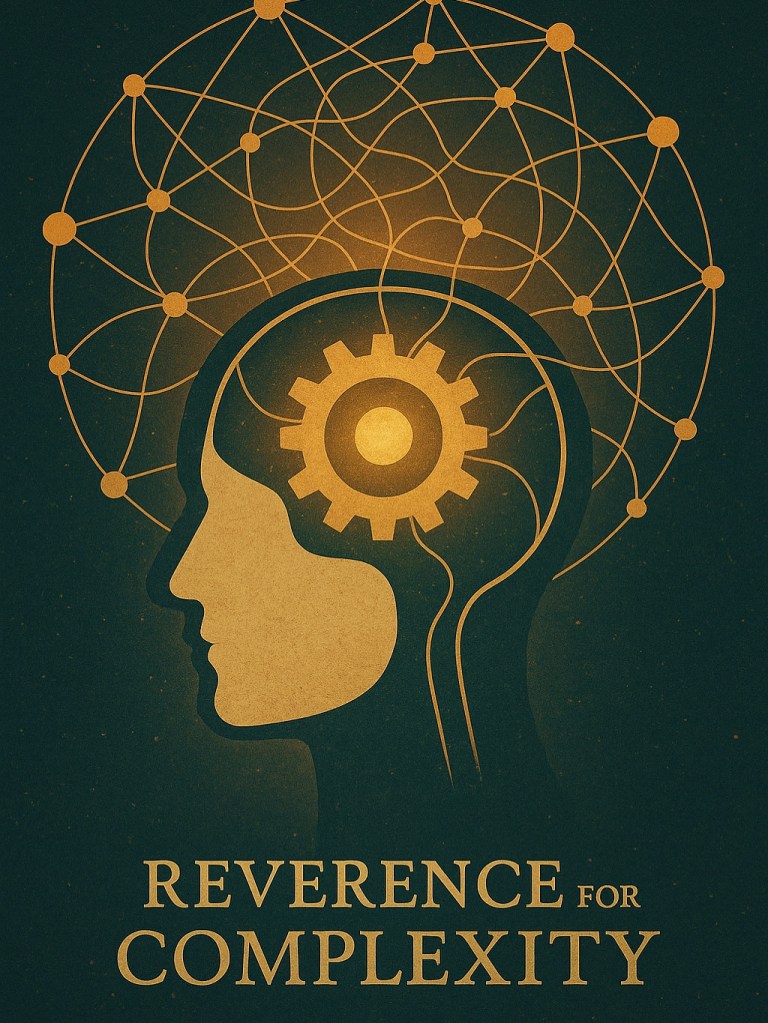
Complex concepts or issues require a holistic mode of analysis—one achieved not by dismantling the structure under study, but by perceiving its many layers through a lens of comprehensive integration.
Such structures are, in a sense, alive. They consist of multiple interconnected parts whose relationships sustain the whole. Each part offers valuable insight into the system’s function, yet the parts themselves are not the living essence; they are the mechanisms through which the structure emerges into being.
To truly comprehend a complex structure, perceiving only the parts will accomplish little. The parts yield knowledge, but not understanding. Only when we grasp both the parts and their intricate interconnections does a coherent framework of meaning begin to appear.
This kind of perception arises from a dynamic, bidirectional process—moving between the proximal and the distal, between the detail and the whole. It is not linear, as if one could first analyze the parts and then simply reassemble them. Complexity demands a more fluid rhythm of inquiry: from part to whole and back again, each movement revealing new patterns of relation and purpose.
Ultimately, this rhythm of perception leads toward a holistic apprehension of the structure—not merely as an isolated phenomenon, but as something woven into the fabric of being itself. In recognizing that connection—to the individual, the collective, and the continuum of space and time—one experiences revelation. And from that revelation arises either rejection or reverence, depending on how deeply the structure aligns with the wholeness of being.
 Michael Thacker