A Depth Psychological Reflection on Meaning, Death, and Rebirth
Author’s Note:
This reflection was written in the aftermath of personal loss. It is not intended as a definitive account, but as a depth-psychological exploration of how death, reflection, and rebirth contribute to the development of meaning and coherence within the psyche.
Life and death are an inevitable part of being. It is through a relational interaction with the fundamental structure of reality that continuity of experience emerges. With this continuity, we discover meaning through sensory excitation and memory formation. This process allows for meaning to both emerge and form as a reflective process. Not only does this process provide a structure of meaning for experiences during the present and past but also provides sustenance for the future as well. It is here that we utilize the meaning of past experiences to discern the path of potential that lies ahead.
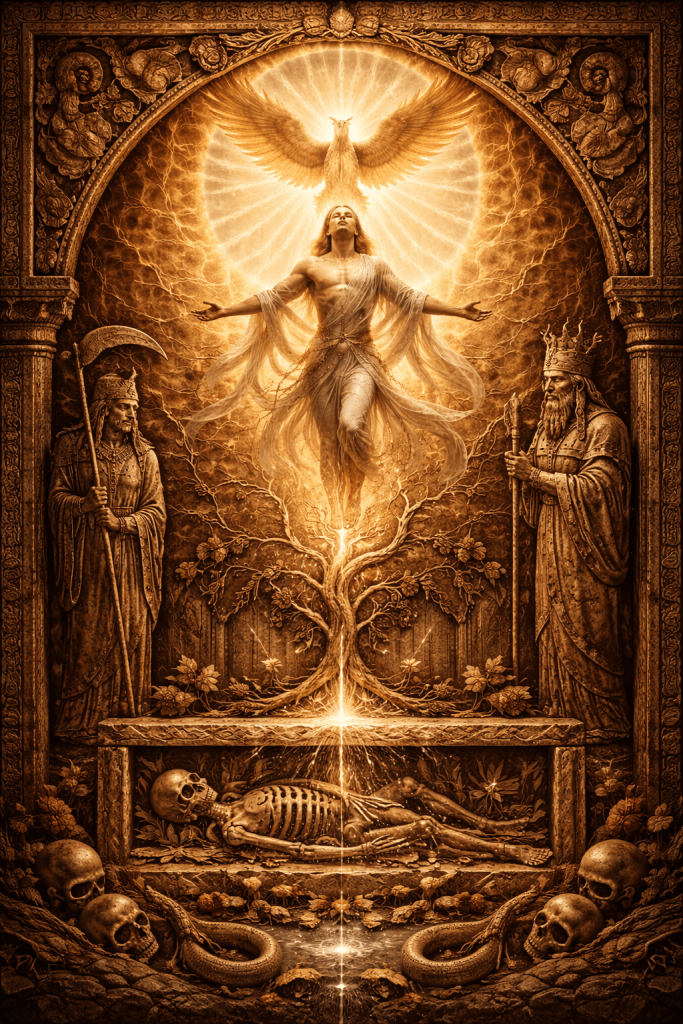
However, the fundamental essence of meaning is found in death — it is through the termination of an experience that allows for reflection and meaning formation. Without death, reflection — and thus significance — cannot fully mature. Psychologically, this is the death of the ego. Any given experience provides stimulation that is necessary for memory formation through sensory modalities that provide significance; however, the significance provided is premature at the moment of experience itself. Only through the process of death can the significance mature and become fully realized.
At the core of this process is the concept of rebirth — it is the experience being experienced in the light of reflective engagement. Rebirth is not simply a remembrance or a re-participatory act of the event itself, but rather it is a process of re-examination that provides novel information of both the experience and the self. It is a conscious attempt to discover what has been experienced in relation to the unconscious part of the self. Here, one is not simply investigating the experience in isolation but in relation to previous experiences of both the individual and the collective — the process of individuation.
Again, this process can only be accomplished through reflective engagement that is relational with the various parts of the self. These various parts of the conscious and unconscious self are often nested in a variety of other experiences that one has had, along with the deeper experiences of the ancestral past that are aggregated into the collective unconscious.
The initial strata of the unconscious are formed through the individual’s engagement with reality. Over time, memories are aggregated into a structure with significance often being the criteria of differentiation — the more significant an experience the easier it is to abstract out of the unconscious structure. With that said, it is due to this that emphasis is placed on reflective engagement with a given experience in relation to other experiences. It is often through the exercise of remembering an event that another experience emerges within the mind. And if this process is deliberate, the more relational experiences and their elements will emerge.
This process is also true of the lower strata of the unconscious where the collective experiences reside, though this level of analysis and relational engagement requires more energy to pursue. Even still, if one does manage to conjure up collective knowledge, it is often difficult to integrate with both the conscious and unconscious experiences of the self. Time, energy, and exceptional focus are necessitated to properly integrate this knowledge with the self into a coherent framework.
Compared to the unconsciousness of the self, the experiences of the collective unconscious manifest themselves in the form of archetypes. These archetypes of primordial images that reflect various parts of the collective human psyche. Each archetype possesses its own personality and history. They are personas of generalized facets of the human experience. For example, the archetype of intuition, or wisdom, is often manifested in the form of the good mother or good father that provides guidance and comfort.
When integrated properly, these archetypes provide an overarching framework by which elements of the self are organized. These categorical frames provide coherence that allow an individual to stabilize and orient themselves in a more conducive manner in the world. Only through the process of life experiences and the death thereof can the process of reflective engagement be initiated. As time elapses, this reflective engagement with the conscious and unconscious parts of the self, in conjunction with the collective unconscious, reveals the essential elements of conscious coherence. From there, these essential elements along with their primordial archetypal relational representations can be categorized into a functional unit that results in the rebirth of the self.
Of course, this resulting rebirth of the self is not some mystical experience — though it can very well be experienced in such a manner — rather it is a reorientation of one’s perception accomplished through a reconfiguration of the psyche. No longer can the world be perceived as it did prior to the rebirth as the alignment of psyche processes and elements are reconfigured in a manner that provides new sustenance to future experiences. A new stimulatory engagement emerges that puts to death the old mode of being, and it is with this new engagement that allows for another cycle of life, death, and rebirth to be experienced yet again.
 Michael Thacker