Tracing the evolution of awareness from quantum entanglement to symbolic self-reflection.
By Michael Thacker
Author’s Note:
This essay explores the evolution of consciousness as an emergent hierarchy — from the proto-conscious field of quantum entanglement to the symbolic articulation of the human psyche. It integrates perspectives from physics, genetics, sensory biology, neuropsychology, and depth psychology to illustrate how awareness unfolds as a unified process across the scales of being.

Introduction
Consciousness has been a mystery to humanity since the initial emergence of writing — and most likely well into our evolutionary past, evidenced in burials of the dead beginning over 100,000 years ago (Zaidner et al., 2025). Early representations of humanity’s awareness of consciousness appeared during the Paleolithic period (≈50,000 BP) as stone carvings of spirals, snakes, and bulls (Gimbutas, 1989). These carvings symbolized “life energy,” or in Jungian terms, the libido (Jung, 1956).
Millennia later, the concept of consciousness evolved from an overarching field that inhabited all life into an individual soul that only humans possessed. The Sumerian word for soul or spirit was gidim, which translated to an animated spirit or ghost of the individual (Choksi, 2014). This concept was developed further in the Old Testament, where everyone possessed a nesama — the “breath of life” or soul. The New Testament writers expanded upon this with the Greek term pneuma to describe the soul of humanity — often translated as “spirit,” but best understood as the rational soul.
The introduction of a rational component to the concept of the soul was revolutionary — signifying a developmental step toward individual significance. This significance can be better understood by examining the evolving religious significance of the individual from Sumer to the first century ACE.
During the third millennium BCE, the Sumerians believed the king to be a god incarnate, possessing the power to govern all things. Centuries later, this concept developed to situate the king as a son of the gods rather than a god himself. However, both roles positioned the king to “inherit” access to dwell with the gods forever in the heavens after death (Neumann, 1954).
As the centuries progressed, so too did this concept of death and resurrection — one that eventually extended to all inhabitants of Babylon (Sumer). The Old Testament writers absorbed this idea, which was further developed in the New Testament. There, all of humanity possesses a “soul,” and through the death and resurrection of Jesus, those who believe in the “king” are granted access to the eternal realm (Neumann, 1954).
Though the symbolic understanding of consciousness (soul) has evolved throughout millennia, a scientific comprehension of this enigma remains elusive. It is therefore necessary to integrate this symbolic dimension within a multifaceted framework of consciousness. The symbolic significance is not a mere artifact of culture but an evolutionary phenomenon that may be directly related to the essence of consciousness itself. Other facets that must be considered include quantum physics, genetics, sensory modalities, neuroanatomy, and symbolism.
To understand consciousness as an emergent hierarchy, we must move beyond the isolated study of its components toward a model that perceives its interdependent strata as facets of a unified field. Each level — quantum, genetic, sensory, neural, and symbolic — contributes to the architecture of awareness in ascending complexity, while remaining rooted in the same underlying continuum of reality.
Hierarchy of Consciousness
These five facets of consciousness — quantum, genetic, sensory, neuroanatomical, and symbolic — are best understood as an amalgamated hierarchy rather than separate qualities. The most fundamental level is the quantum realm, where proto-consciousness resides. This level is followed by the genetic structures inherent within multicellular organisms that help “activate” aspects of consciousness into existence. From there, consciousness is experienced and further developed through the sensory and neuroanatomical systems. Finally, it emerges into symbolic articulation — the self-reflective expression of awareness.
The Quantum Foundation: Proto-Consciousness and the Field of Entanglement
Quantum physics pertains to the realm of particles and their subcomponents — a peculiar realm of unpredictability where particles exist as both wave and particle simultaneously (Li et al., 2023). Only when an observer (consciousness) interacts with these particle-waves does the wavefunction collapse and the particle aspect solidify. This solidification gives rise to the tangible reality we engage with daily — from trees and buildings to one another (Codex, 2023).

Multiple experiments over the past two centuries have demonstrated that a particle must be observed to solidify. The first was Young’s famous “double-slit” experiment, wherein photons shot through double slits produced a wave pattern, revealing the paradox of wave-particle duality and the instantaneous, communicative nature of reality (Kim & Ham, 2023).
A later study by the Weizmann Institute of Science (1998) used a sophisticated detector to spot passing electrons and found that — even without human observation — the particles “knew” they were being detected, collapsing their wavefunction. This not only illustrates the entangled nature of particles but also suggests the presence of proto-consciousness.
A more recent experiment by Vedovato et al. (2017) supported this view. Their satellite-ground interferometer extended thousands of miles into space, reflecting photons through complex mirror configurations. At the final moment, the photons collapsed from wave to particle — seemingly aware of the measurement decision through a phenomenon known as retrocausality.
The accumulating evidence supports the idea of a proto-conscious awareness capable of communicating with itself across time. This instantaneous, interconnected communication suggests a fundamental field of proto-conscious activity from which higher forms of consciousness emerge.
Genetic Mediation: The Biological Encoding of Awareness
Deoxyribonucleic acid (DNA) — the double-helix molecule that underlies all life — encodes, transmits, and expresses information (Openstax, 2021). Through epigenetics, genes can be switched on or off depending on environmental factors, allowing traits to manifest as genotypes or phenotypes (Meza-Menchaca et al., 2024). Over roughly 3.8 billion years, this process has driven life’s evolution (Kitadai & Maruyama, 2018).
DNA sustains an organism’s biological functionality across generations, yet this continuity is adaptable. Environmental pressures can activate or deactivate genes, producing new physical and behavioral traits (Meza-Menchaca et al., 2024). Over time, this process gave rise to major evolutionary transitions — such as the first fish adapting to land through genetic activation that eventually produced limbs and lungs (Gregory, 2008).
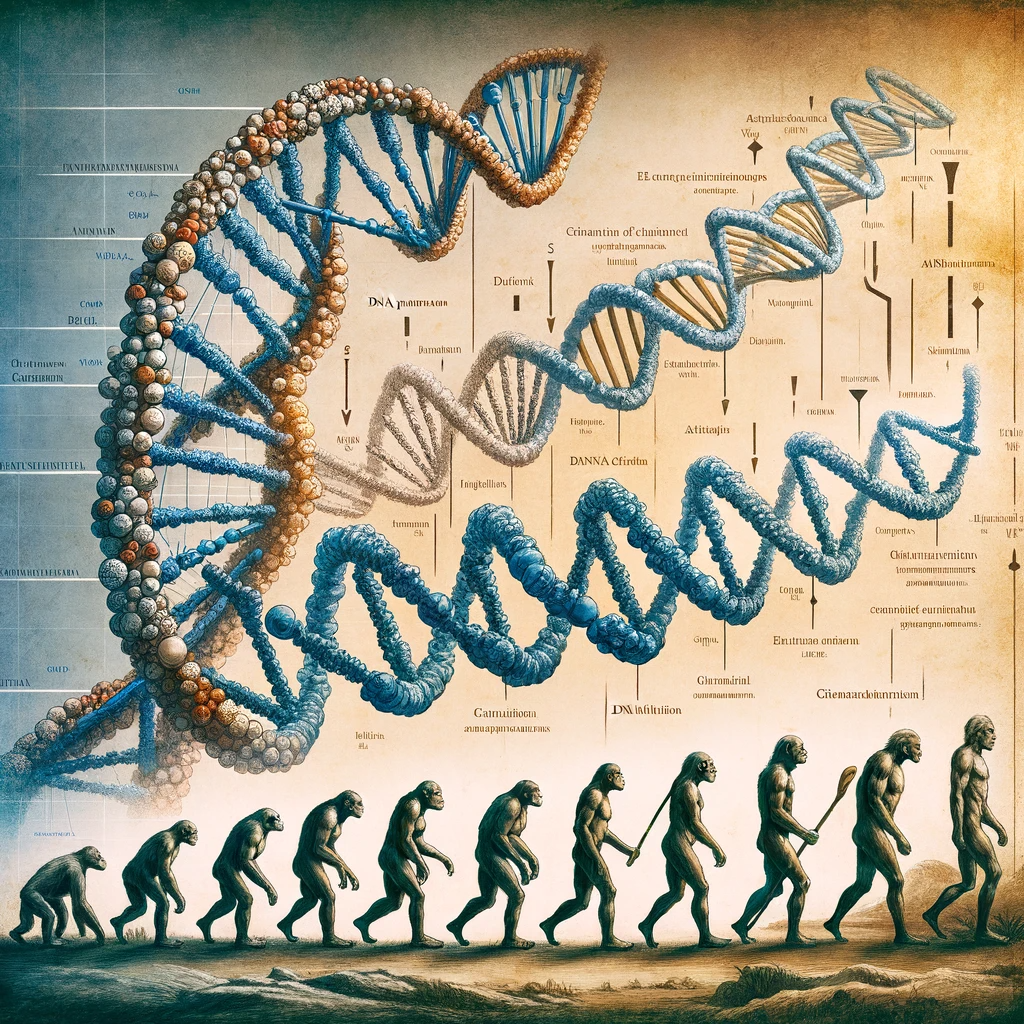
Epigenetics also shapes cognition. Libedinsky et al. (2025) revealed that shifts in gene expression correlate with cognitive advancements, such as the divergence of Homo sapiens and Neanderthals roughly 600,000 years ago — a period marked by dramatic increases in brain size and complexity.
Because these biological structures are composed of subatomic particles, DNA itself may participate in the same proto-conscious field. Thus, as organisms grow in complexity, consciousness likewise evolves into a more intricate, self-referential structure that enhances survival and adaptability.
Sensory Integration: The Embodied Gateways of Awareness
Evolving from this genetic-environmental interplay were the sensory modalities essential for engagement with the environment. These include visual, auditory, gustatory, olfactory, and vestibular systems (Frangeul et al., 2016).

Sensory systems allow organisms to gather and process information necessary for survival — locating food, identifying threats, navigating terrain (Roca et al., 2025), and making adaptive decisions (Zheng & Gu, 2024). As sensory modalities evolved, so did the capacity for multisensory integration, enabling organisms to analyze and interpret complex stimuli (Kanemura & Kitano, 2023). In hominids, this refinement paralleled the expansion of neuroanatomical features responsible for perception and thought.
Neuroanatomical Integration: The Architecture of Perception and Experience
Human cognition evolved alongside the brain’s structural transformation — increases in cortical folding, myelination, and hemispheric differentiation. This allowed greater information processing and more nuanced perception of reality.
McGilchrist (2019) highlights this hemispheric differentiation: the right hemisphere perceives holistically, attuned to ambiguity and relational context, while the left is analytical, focused on precision and control. The right hemisphere perceives patterns and meaning; the left isolates and defines.
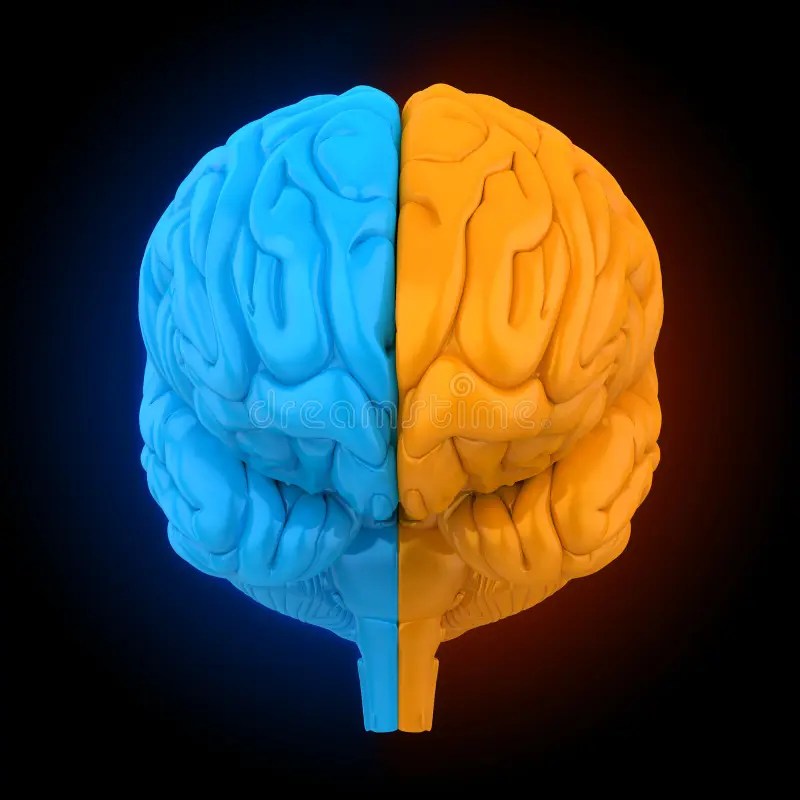
This dual architecture mirrors the wave-particle duality of reality itself — the right hemisphere reflecting the wave’s uncertainty, the left embodying the particle’s stability (Codex, 2023; McGilchrist, 2019).
Symbolic Expression: Consciousness Reflecting Upon Itself
Perception is shaped not only by neuroanatomy but by the internal dialogue of thought. As humans evolved, subjective processing deepened — culminating in the symbolic articulation of internal experience.
Around 50,000 years ago, early humans began to carve and paint symbols on cave walls, transforming inner perception into external representation (Neumann, 1956; Srivastava, 2020). These were not mere depictions but expressions of consciousness becoming self-aware.

Developmentally, the human child follows a parallel path. Around age four, children begin expressing inner perception symbolically, later refining this into language and abstract reasoning (Babakr et al., 2019; Yu & Nagai, 2020). Such self-expression signals individuality — the emergence of a meta-aware self capable of reflection and empathy.
Through millennia, symbolic articulation matured — from cave art to writing, myth, religion, and science — each an externalization of the psyche’s evolution (Jung, 1956).
Entangled Awareness: The Unity of Consciousness and Reality
The five facets of this amalgamated hierarchy — quantum, genetic, sensory, neuroanatomical, and symbolic — collectively compose a coherent architecture of awareness.
Connection with reality begins at the quantum level, where the wave-particle duality allows matter and mind to co-participate. Through quantum entanglement, this wavefunction interacts with the organized particle systems of living organisms, forming the basis of consciousness as a dynamic field of interrelation.
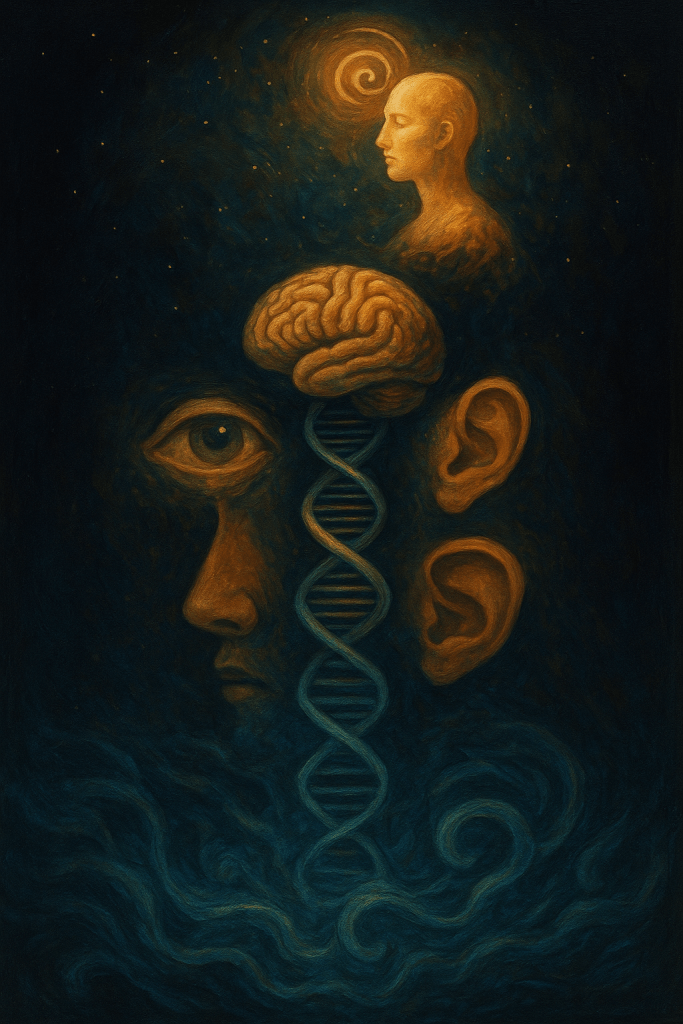
As this system grows in complexity, it acquires the capacity for self-reference and reflection. Organisms with advanced sensory and neural systems not only perceive their environment but interpret it — shaping and being shaped by it in turn.
At higher levels, consciousness interacts within the overarching quantum-entangled field, allowing each individual awareness to be both unique and unified — an independent locus of perception within the shared web of existence.
Consciousness, therefore, may not merely observe reality but participate in its unfolding — each act of awareness a mirror in the cosmic field reflecting itself into being.
References:
Babakr, Z., Mohamedamin, P., Kakamad, K. (2019). Piaget’s cognitive developmental theory: Critical review. Education Quarterly Reviews, 2(3), 517-524. doi: 10.31014/aior.1993.02.03.84
Choksi, M. (2014). World History Encyclopedia. Retrieved from https://www.worldhistory.org/article/701/ancient-mesopotamian-beliefs-in-the-afterlife/
Codex, Y. (2023). The role of observers in physics: Shaping physical phenomena through quantum information theory. Yubetsu Codex Quantum physics, 1(2). https://codex.yubetsu.com/article/2260bb6fff034a859acc020441a50f31
Frangeul, L., Pouchelon, G., Telley, L., Lefort, S., Luscher, C., & Jabaudon, D. (2016). A cross-modal genetic framework for the development and plasticity of sensory pathways. Nature, 538(7623), 96–98. https://doi.org/10.1038/nature19770
Gimbutas, M. (1989). The language of the goddess. Harper San Francisco.
Gregory, T.R. The evolution of complex organs. Evolution Education Outreach, 1, 358–389 (2008). https://doi.org/10.1007/s12052-008-0076-1
Jung, C. (1956). Symbols of transformation. Princeton University Press.
Kanemura, I., & Kitano, K. (2023). Association between different sensory modalities based on concurrent time series data obtained by a collaborative reservoir computing model. Scientific reports, 13(1), 173. https://doi.org/10.1038/s41598-023-27385-x
Kim, S., & Ham, B. S. (2023). Revisiting self-interference in Young’s double-slit experiments. Scientific reports, 13(1), 977. https://doi.org/10.1038/s41598-023-28264-1
Kitadai, M. & Maruyama, S. (2018). Origins of building blocks of life: A review[J]. Geoscience Frontiers, 9(4), 1117-1153. DOI: 10.1016/j.gsf.2017.07.007
Li, J. K., Sun, K., Wang, Y., Hao, Z. Y., Liu, Z. H., Zhou, J., Fan, X. Y., Chen, J. L., Xu, J. S., Li, C. F., & Guo, G. C. (2023). Experimental demonstration of separating the wave‒particle duality of a single photon with the quantum Cheshire cat. Light, science & applications, 12(1), 18. https://doi.org/10.1038/s41377-022-01063-5
Libedinsky, I., Wei, Y., de Leeuw, C., Rilling, J. K., Posthuma, D., & van den Heuvel, M. P. (2025). The emergence of genetic variants linked to brain and cognitive traits in human evolution. Cerebral cortex, 35(8), bhaf127. https://doi.org/10.1093/cercor/bhaf127
McGilchrist, I. (2019). The master and his emissary. Yale University Press.
Meza-Menchaca, T., Albores-Medina, A., Heredia-Mendez, A. J., Ruíz-May, E., Ricaño-Rodríguez, J., Gallegos-García, V., Esquivel, A., Vettoretti-Maldonado, G., & Campos-Parra, A. D. (2024). Revisiting epigenetics fundamentals and its biomedical implications. International journal of molecular sciences, 25(14), 7927. https://doi.org/10.3390/ijms25147927
Neumann, E. (1954). The origins and history of consciousness. Princeton University Press.
OpenStax. (2021). Biology 2e. OpenStax, Rice University. https://openstax.org/books/biology-2e/pages/1-introductionm
Roca, M., Eren, G. G., Böger, L., Didenko, O., Lo, W. S., Scholz, M., & Lightfoot, J. W. (2025). Evolution of sensory systems underlies the emergence of predatory feeding behaviours in nematodes. bioRxiv : the preprint server for biology, 2025.03.24.644997. https://doi.org/10.1101/2025.03.24.644997
Vedovato, F., Agnesi, C., Schiavon, M., Dequal, D., Calderaro, L., Tomasin, M., Marangon, D. G., Stanco, A., Luceri, V., Bianco, G., Vallone, G., & Villoresi, P. (2017). Extending Wheeler’s delayed-choice experiment to space. Science advances, 3(10), e1701180. https://doi.org/10.1126/sciadv.1701180
Weizmann Institute Of Science. (1998). Quantum theory demonstrated: Observation affects reality. ScienceDaily. www.sciencedaily.com/releases/1998/02/980227055013.htm
Yu, L., & Nagai, Y. (2020). An Analysis of Characteristics of Children’s Growth through Practical Art. Healthcare (Basel, Switzerland), 8(2), 109. https://doi.org/10.3390/healthcare8020109
Zaidner, Y., Prévost, M., Shahack-Gross, R., Weissbrod, L., Yeshurun, R., Porat, N., Guérin, G., Mercier, N., Galy, A., Pécheyran, C., Barbotin, G., Tribolo, C., Valladas, H., White, D., Timms, R., Blockley, S., Frumkin, A., Gaitero-Santos, D., Ilani, S., Ben-Haim, S., … Hershkovitz, I. (2025). Evidence from Tinshemet Cave in Israel suggests behavioural uniformity across Homo groups in the Levantine mid-Middle Palaeolithic circa 130,000-80,000 years ago. Nature human behaviour, 9(5), 886–901. https://doi.org/10.1038/s41562-025-02110-y
Zheng, Q., & Gu, Y. (2024). From Multisensory Integration to Multisensory Decision-Making. Advances in experimental medicine and biology, 1437, 23–35. https://doi.org/10.1007/978-981-99-7611-9_2
 Michael Thacker