Tracing the roots of tribalism through evolutionary psychology and hemispheric neuroscience

Extremism is rampant in modern society, whether on the left or right of the spectrum. This trend has been especially evident since the 1960s, when radical ideas began to emerge across culture, society, and politics (Library of Congress, n.a.). The left reacted to restrictive conservative values, which in turn provoked an intensified response from the conservative camp. By the 1990s, this polarization deepened substantially, with each side clinging to its extreme values “with the grip of a boa constrictor” (Brenan, 2025). Driving this polarization is the majority of the population, drawn passionately to one side or the other, often guided more by emotion than contextual or integrative reasoning. Violence has been the inevitable consequence, with little reprieve in sight. Understanding the root of this issue through an evolutionary and neuroanatomical lens can clarify its origins and point toward solutions.
Evolutionary Tribalism: The Roots of Human Extremism
What drives an evolved species to engage in such extremities? One explanation is the propensity of susceptible individuals to seek identity and comfort in the dogmatic structures of ideological frameworks. This tribal mindset that has been prevalent since we last shared a common ancestor with chimpanzees some six million years ago—and perhaps further still (Almécija et al., 2021). Like chimpanzees, humans evolved within groups that demanded conformity to social norms—implicit in their early form, later made explicit (Clark et al., 2019). Transgressors were killed or exiled. Beyond the tribe lay predators and rival groups, making conformity essential for survival (Wrangham, 2019).

The threat of excommunication still lingers within the collective unconscious today. This is especially pronounced among those with lower need for cognition (NFC)—a trait describing intrinsic motivation for complex cognitive thinking and problem-solving (Liu & Nesbit, 2023). High NFC often correlates with gifted-level intelligence (IQ 120+), while lower NFC is more common in the average range (roughly 115 and below). This distribution reflects humanity’s evolutionary past: most survived by conforming to tribal norms, while only a minority engaged in deeper abstraction (Scherrer et al., 2024). This explains why the majority still find comfort in tribal frameworks (Heck et al., 2018).
Neuroanatomical Perception: The Divided Brain at Work
Anatomically—and in line with Iain McGilchrist’s work (2009)—tribalism resides within the restrictive context of the brain’s left-hemisphere. Here, the world is apprehended and categorized into parts, often perceiving others as objects while promoting an “us-vs-them” mentality. The left hemisphere builds schematic frameworks resistant to Piagetian accommodation, limiting adaptability (Hanfstingl et al., 2022). This encourages linear, rigid thinking, regardless of political orientation.

In contrast, the right hemisphere attends to reality holistically, fostering contextual, integrative perception. Adaptability and empathy flourish here, enabling more functional orientations to reality (McGilchrist, 2009).
Balanced Solution: Toward Adaptation and Integration
Both hemispheres are necessary, but the left often asserts dominance with certainty. This certainty is anchored in frameworks built from experience, though these partial at best. Left unchecked, the left hemisphere resists novel information, risking a totalitarian mindset imposed on both self and society. Only when the hemispheres cooperate—when the left provides structure and the right updates it—can a holistic and empathetic perception emerge (McGilchrist, 2009).
The solution lies at the most fundamental level: individual adaptation. As the individuals adapt, so too do their societies. On the left, compassion is noble but incomplete without genuine perspective-taking. On the right, preservation is necessary but requires contextual updating. Both sides would benefit from a deeper understanding of opposing views—not just superficially grasping “what” others believe, but thoroughly exploring why. This expansion of comprehension not only tempers extremism but may even draw extremes toward consensus.
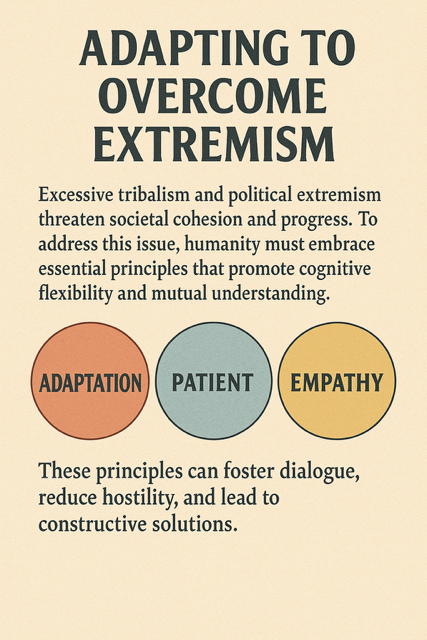
Evolutionarily, adaptation enables humans to survive in hostile changing environments. Exposure to novel conditions demanded critical thinking, strategy, and cooperation. Today, the greatest threat is not environmental but internal: the disintegration of cohesion through extremism. Only through exposure to alternative ideas, critical analysis, and synthesis can society rediscover cohesion. Adaptation, patience, and empathy must become the focus if humanity is to resist fragmentation.
Almécija, S., Hammond, A. S., Thompson, N. E., Pugh, K. D., Moyà-Solà, S., & Alba, D. M. (2021). Fossil apes and human evolution. Science (New York, N.Y.), 372(6542), eabb4363. https://doi.org/10.1126/science.abb4363
Brenan, M. (2025). U.S. political parties historically polarized ideologically. Gallup. https://news.gallup.com/poll/655190/political-parties-historically-polarized-ideologically.aspx
Clark, C. J., Liu, B. S., Winegard, B. M., & Ditto, P. H. (2019). Tribalism Is human nature. Current Directions in Psychological Science, 28(6), 587-592. https://doi.org/10.1177/0963721419862289
Hanfstingl, B., Arzenšek, A., Apschner, J., & Gölly, K. I. (2022). Assimilation and accommodation: A systematic review of the last two decades. European Psychologist, 27(4), 320–337. https://doi.org/10.1027/1016-9040/a000463
Heck, P. R., Simons, D. J., & Chabris, C. F. (2018). 65% of Americans believe they are above average in intelligence: Results of two nationally representative surveys. PloS one, 13(7), e0200103. https://doi.org/10.1371/journal.pone.0200103
Library of Congress (n.a.). Hope for America: Performers, politics and pop culture. https://www.loc.gov/exhibits/hope-for-america/polarization-in-the-1960s.html
Liu, Q., & Nesbit, J. C. (2023). The relation between need for cognition and academic achievement: A meta-analysis. Review of Educational Research, 94(2), 155-192. https://doi.org/10.3102/00346543231160474
McGilchrist, I. (2009). The master and his emissary: The divided brain and the making of the western world. Yale University Press.
Scherrer, V., Breit, M., & Preckel, F. (2024). Crystallized intelligence, fluid intelligence, and need for cognition: Their longitudinal relations in adolescence. Journal of Intelligence, 12(11), 104. https://doi.org/10.3390/jintelligence12110104
Wrangham, R. (2019). The goodness paradox: The strange relationship between virtue and violence in human evolution. Vintage Publishing.
 Michael Thacker